The Real Meaning behind Taylor Swift’s “The Fate of Ophelia”
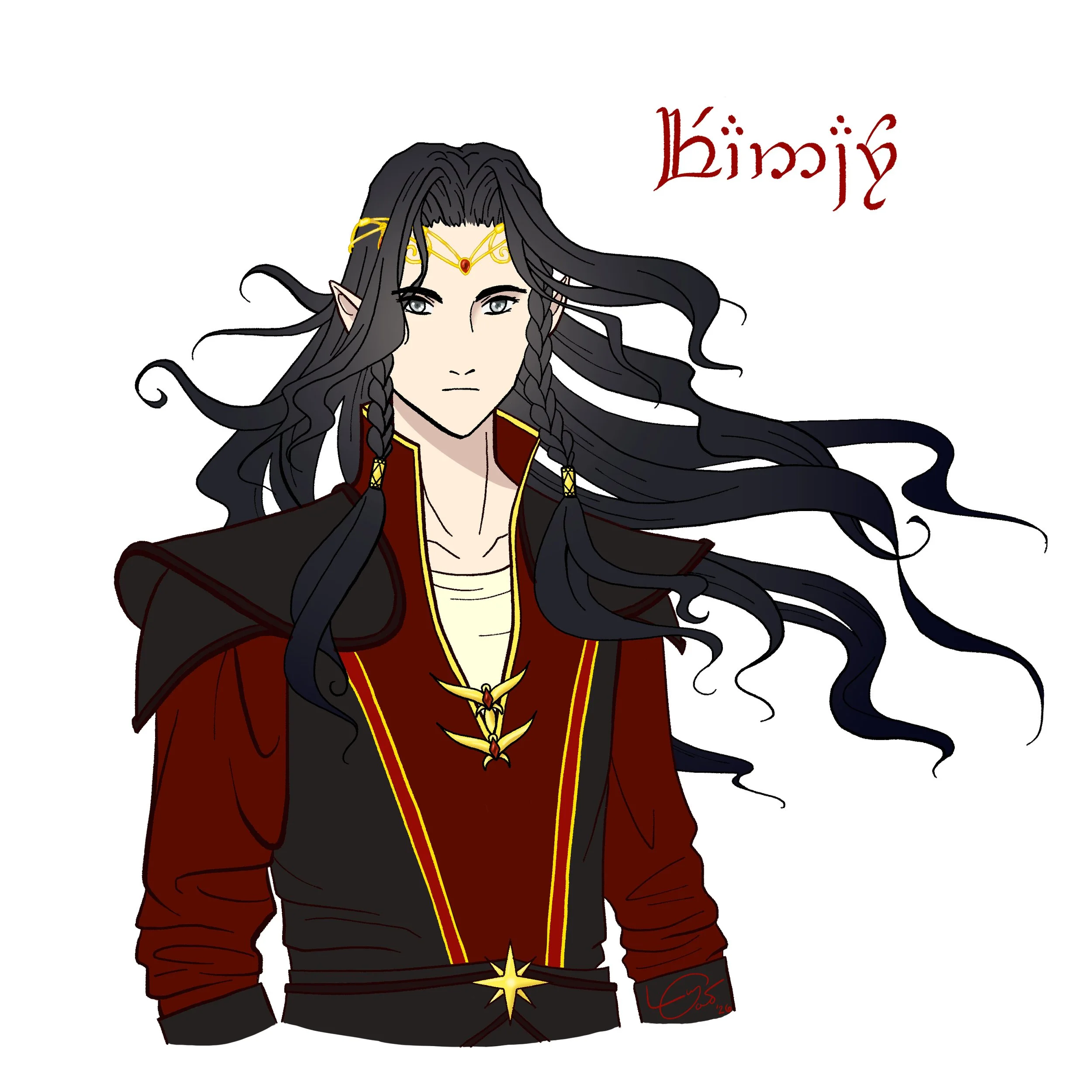
I drew this picture of Fëanor, and I guess I’m going to keep using it.
So I have this theory.
Taylor Swift’s “The Fate of Ophelia” is actually a love song to Fëanor. Yes, the elf from The Silmarillion that I keep bringing up. Have I mentioned it’s the 25th anniversary of the Lord of the Rings movies?
Let’s explore that!
Song Analysis
“The Fate of Ophelia” begins thusly:
I heard you calling,
On the megaphone
You wanna see me all alone.
As legend has it you
Are quite the pyro.
You light the match to watch it blow.
We are going to start off very straightforwardly here, with “pyro” and “match.” This is a clear and obvious reference to Fëanor, whose name means “Spirit of Fire” (Fëanor is a half Sindarized version of his name in Quenya: Fëanáro, from “fëa”, meaning “spirit” or “soul”, and “nár”, meaning “fire”). As a smith, Fëanor would have worked with fire quite a bit. One of his infamous actions was burning the Teleri swan ships at Losgar so that his brother could not use them (half-brother; sorry, sorry). And when he died, the strength of his spirit was such that he quite literally burst into flame. Calling him a pyro is extremely accurate.
*Side note: I refuse to stand by the slander that he accidentally killed Amrod when he burnt the ships. Amrod died with Amras during the assault on Sirion. Fight me.
And if you'd never come for me,
I might've drowned in the melancholy.
I swore my loyalty to me, myself and I,
Right before you lit my sky up.
“Lit my sky up” has dual meanings – again, when he died, Fëanor burst into flame, arguably (though briefly) lighting up the sky.
But this could also be a reference to the third silmaril! The silmarils were Fëanor’s famous works, stolen by Morgoth and placed into a crown (put a pin in that). Fëanor and his host came east to try to retrieve them, but Fëanor died extremely early in the campaign (again, self-immolating). In the end, one silmaril became a star – the Star of High Hope – a very bright star that Elrond’s father sails across the night sky (and the star whose light Galadriel traps in a vial for Frodo in Lord of the Rings). It thus helps to light the sky, and as one of Fëanor’s works, can and should be attributed to him.
We will return to the silmarils in a moment; this is not the only reference to them.
As for “I swore my loyalty to me, myself and I,” Fëanor is also extremely well known for The Oath, which he and his sons took after the theft of the silmarils. The Oath was arguably one of the major driving forces at work during the First Age of the Sun, causing events such as the Kinslayings, and was considered unbreakable. Oaths are very important to Fëanor. Referencing an oath makes a lot of sense in a song about him, and this has a vaguely romantic twist to it, as the singer is saying she swore one to herself before Fëanor entered her life.
Presumably she would have sworn The Oath with Fëanor and his sons, unlike Nerdanel, Fëanor’s canonical wife.
All that time
I sat alone in my tower,
You were just honing your powers,
Now I can see it all (see it all).
Fëanor is considered the greatest of the Noldor, known for his smithing, gem-crafting, and language work (have you heard about the thorn?). Honing his skills in those disciplines can certainly be considered “honing [his] powers,” something he spent a lot of time doing (roughly the equivalent of 3000 Years of the Sun, if you consider one Year of the Trees to be equivalent to 9.582 Years of the Sun. No, I’m not going to explain that further; Tolkien Gateway is right there.)
(I bet you didn’t expect citations in this blog post.)
I see nothing wrong with the singer saying she spent time in a tower. Lots of elvish settlements have towers, especially Noldor ones (but also Sindar – Thingol did imprison his daughter Lúthien in a tower at one point. Then Celegorm may have also imprisoned Lúthien in a tower in Nargothrond later? She also sang down one of Sauron’s towers. Girl needed to stay away from towers). Checks out.
Late one night
You dug me out of my grave and
Saved my heart from the fate of
Ophelia.
Keep it one hundred
On the land, the sea, the sky.
“Keep it 100” is slang for being completely real/honest/true. For all Fëanor’s faults, lying is not one of them. In fact, some white lies on his part might have solved some issues, but he just wasn’t going to do that, instead choosing to be brutally honest to basically everyone’s detriment (arguably, including his own). The singer can be assured Fëanor will “keep it 100” at all times.
“On the land, the sea, the sky” is an obvious reference to the resting places of the three silmarils. We’ve already briefly touched on the silmaril in the sky. The other two were taken from Morgoth’s crown at the end of the War of Wrath, and stolen from the host of the Valar by Fëanor’s two remaining sons, Maedhros and Maglor, after Eonwë refused to return their father’s stolen property to them. Each one took a jewel, but because of the evil they had done in order to claim them (including, but not limited to, four kinslayings), the jewels burnt them. Unable to bear the pain, Maedhros took his and threw himself into a fiery chasm, and Maglor threw his into the sea (and became something like a beach cryptid, haunting the shoreline with sad songs). Thus the three silmarils found their final resting places – land, sea, and sky.
Pledge allegiance to your hands,
Your team, your vibes
Again! We have Oath vibes here. After having originally sworn allegiance to herself, the singer now swears allegiance to Fëanor and his House (the Pledge of Allegiance is a kind of oath, after all, even if it’s not nearly as cool as the Oath of Fëanor).
Don't care where the hell you been,
'Cause now you're mine.
It's 'bout to be the sleepless night
You've been dreaming of.
The fate of Ophelia.
“Don’t care where the hell you’ve been” could potentially reference a couple of things. It could refer to the fact that, after drawing a sword and pointing it at the throat of his half-brother Fingolfin, Fëanor was exiled to Formenos for the equivalent of roughly 114 Years of the Sun, thus removing him from Tirion, the center of Noldor politics. It could also reference the fact that Fëanor is dead, and thus removed to the Halls of Mandos for the foreseeable future. In both cases, he would be an absentee for a long period of time, which the singer of the song forgives him for, since at least now he’s hers.
I refuse to explain more about “the sleepless night you’ve been dreaming of.” Fëanor had seven sons. Extrapolate.
The eldest daughter of a nobleman,
Ophelia lived in fantasy.
But love was a cold bed full of scorpions;
The venom stole her sanity.
I’ve ignored the use of Ophelia from Hamlet up to this point, but now is as good a time as any to address it. The singer is using her interpretation of Ophelia from Hamlet to refer to herself and her situation, which was (pre-Fëanor) Not Good. This might be the most controversial thing I’ve said yet, but… you don’t have to take the Ophelia thing literally. It’s the vibes of Ophelia. The word “vibes” is literally already in this song. This is a pop song, not high art. The singer can use whatever metaphor to refer to herself that she desires. You don’t have to agree with it for it to mean something to her.
And if you'd never come for me
I might've lingered in purgatory
Elves don’t technically have purgatory, but they do have the Halls of Mandos, which I have previously mentioned. Let’s explore that idea a little further.
Basically, elves are immortal, and they are also bound to the world. If their body dies, their soul cannot leave, like the souls of Men do. So they go to the Halls of Mandos to heal, and when they are ready, they are rehoused in a new body. I’d say that, as a place for waiting while dead, the Halls can align loosely with the idea of purgatory, which is also a place souls go to be purified before they are ready for the next step of their cosmic adventure.
You wrap around me like a chain, a crown, a vine
Pulling me into the fire
Oh, a crown? A CROWN, YOU SAY? Such as perhaps:
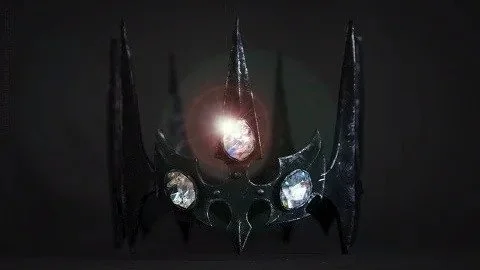
The Crown of Morgoth (brought into more mainstream public awareness due to its appearance on the Amazon show Rings of Power), into which the three stolen silmarils were set???
Coincidence? I think not.
This is so clear I don’t think I have to say any more on it.
A chain is also fairly straightforward imagery. Fëanor was a smith, and probably would have made a fair number of chains over the course of his 3000 years (considering his gem-smithing, probably the kind of decorative chains that are popular for jewelry). The Noldor are very fond of jewelry and gems. Fëanor almost certainly made a fair amount of jewelry – jewelry that he would have given to his partner (I can’t see the “greatest smith of the Noldor” content with his partner wearing jewelry made by someone else, at least not most of the time). So she would literally have his “chains” wrapped around her throat and wrists via necklaces and bracelets.
And a vine is just a chain made of plant.
Also, we have even more fire imagery. Fëanor is fire. He’s pulling her into him. She can’t escape his orbit.
[refrain repeats]
'Tis locked inside my memory
And only you possess the key
No longer drowning and deceived
All because you came for me
[bridge repeats]
Let’s be honest, it’s only a small hop from “the greatest smith of the Noldor” to “locksmith.” I’m sure that was well within his abilities, after ~3000 years working a forge. He probably dabbled in a number of disciplines. He had the time.
Also, now we have some drowning imagery – yes, from Ophelia drowning in Hamlet, I am aware, but also water (the element) exists in opposition to fire. She’s no longer drowning because she is with the Spirit of Fire. He’s evaporating the water. That’s how hot he is.
…Hot like temperature-wise. But I guess the other way too? Tolkien does describe him as “...the mightiest in all parts of body and mind: in valour, in endurance, in beauty, in understanding, in skill, in strength and subtlety alike” so I don’t actually think that’s much of a reach.
One minor note: “Deceived” – the Deceiver is Sauron, so maybe he’s also involved in this somehow. Morgoth spent a lot of time and effort in attempting to steal the silmarils, and Sauron was his lieutenant. Lots of people were deceived by Sauron, not in the least Celebrimbor (Fëanor’s grandson who created the rings of power). Maybe it’s a love triangle.
And “all because you came for me”? Well, if there’s one thing you can say about Curufinwë Fëanáro, it’s that he went all in on retrieving things he considered his.
[refrain repeats]
Liz — why did you have us read this?
Video essays and other opinion pieces are a dime a dozen on the internet nowadays. Some of my favorite YouTube content is obsessively researched four-hour long videos on various topics (want recs? Check out Jenny Nicholson, Hbomberguy, KrimsonRogue, and ContraPoints).
But.
Two points.
There’s this thing I’ve noticed, where people (especially online, but increasingly more in person as well) will choose content creators/writers/opinionists that they agree with, and then treat their words like they come from God himself. The proof isn’t the evidence presented; the proof is “so-and-so said so,” and that is a problem.
The other issue is that it is very, very easy to over-analyze a piece of media, which in itself isn’t necessarily a bad thing, until – again – people start treating the words of the analyzer as gospel.

I thought “The Fate of Ophelia” would be fun to do because so many people are so sure what it’s about and are also tearing it apart (and, because I’ve been doing a lot of Lord of the Rings tie-in stuff this year, my brain immediately latched onto some of the lines above and was like “lol, that could refer to Fëanor and the silmarils,” and I thought that was funny). A lot of people have Thoughts and Feelings about many of Swift’s songs, and Swifties (and others, for that matter) like to try to read into her songs to a truly insane degree, creating links and references and connections that would make Charlie Kelly from It’s Always Sunny in Philadelphia proud. And sometimes they are right, but here’s the thing – sometimes they aren’t.
In doing these kinds of analysis, a lot of people will ignore parts of a work that don’t agree with what they are saying. I could not tease out a connection for “dug me out of my grave,” for example, even though I really wanted to (I stared at it for four hours, thumbed through my incredibly abused copy of The Silmarillion, thumbed through my less abused copy of Morgoth’s Ring, read some fanfic. Nothing. I’m disappointed in myself.)
It’s also pretty easy to find parallels to things that were definitely, 100% unintended by the writer. Sometimes this does show some sort of unconscious bias in the case of the writer, but it can also show unconscious bias in the case of the reader. Some things can even be read in multiple ways depending on the reader’s bias (see my “keep it 100” explanation up above, where I chose the more general slang meaning, instead of the Taylor Swift/Travis Kelce specific meaning of 87+13). If you want to read into a song or book that it’s striking out against someone specific, then yeah, sure, there are a lot of examples out there, but even with all your carefully gathered evidence you just don’t know what the truth of the matter is unless the writer comes out and confirms it.
Sometimes, the curtains are blue simply because the writer likes the color blue. Or maybe it rhymes with what comes next.
That’s the thing with poetry and vague references. They can be so vague and/or poetic that teasing out the real source or meaning of the reference can be difficult, and if you come into it with any sort of bias, that is going to color how you make those connections.
This is not to say that analysis is useless. On the contrary, it’s extremely useful. We can learn things about both ourselves, society, and the author of a piece by how we and others read a work. But not everyone online knows what they are talking about, and sometimes even people who do know what they are talking about are trapped by what they perceive is going on, not what the writer was actually thinking. You are actually learning only about the person doing the analysis, and almost nothing about the piece itself or its author.
So the next time you watch a video essay, or read an opinion article, or see guests come to comment on the news, consider that those people also have bias. It doesn’t mean you should throw out everything those people say – they wouldn’t be saying it if they didn’t believe it (probably) – but it does mean you should consider the source. What is their agenda? Why do they want to present this information in this fashion? What is the context of what they are saying? Ideally, you should be gathering multiple opinions on something – and then coming up with your own. You should not simply be regurgitating something someone else said just because “I saw it in a YouTube video/on the news/in a book/etc.”
You have to think for yourself.
But what do I know? I, too, am just a random person on the internet.
Anyways, join me next month when I explain definitively that Fëanor’s silmarils are actually the golden goddesses from the Zelda franchise.
Cheers!
(Also, if any of you actually use this as evidence as to the song being about Fëanor, I swear– oh, wait, not supposed to do that. Swearing oaths is bad; Fëanor taught me that.)
Did I convince you “The Fate of Ophelia” could be about Fëanor? How do you feel about many current internet analyses of songs and books? Have there ever been any where you saw it and were like “…well, that’s not right”?
Comment down below!