Worldbuilding vs. Writing a World
This topic is geared a little more towards writers than readers, but who knows – writers usually start out as readers, and some readers may be interested in aspects of the writing process. Regardless, be assured that it will come back around to Lord of the Rings later in this blog post, because of course it will.
Also of note, to understand what I’m talking about at all here, know that I am drawing a somewhat arbitrary line between the concepts of “worldbuilding” and “writing a world,” though there is obvious overlap and one can lead to the other. The difference, in my opinion, is intention. For the sake of this article, let us define:
“Worldbuilding”: coming up with world details to benefit and complement a story. The worldbuilding exists because the story does.
“Writing a World”: creating a large playground which one may use to write stories. The stories exist because the world does.
Generally, I’d argue most people use “worldbuilding” for both, but I think there’s an interesting structural difference here. Worldbuilding is for the sake of supporting the story being told; writing a world creates events and places and people who might not even be relevant to that story – but they exist nonetheless.
For example: If you are writing a story with a villain character, you probably will consider what events shaped that villain and led to the creation of their evil/morally reprehensible but still understandable manifesto. That’s worldbuilding. But will you consider the events that preceded those? What about decisions made centuries before that led to policy changes that stagnated over time so they got abused to the point where they damaged/were taken advantage of by your villain? What other events besides the rise of the Villainous Viscount occurred because of those? Could other stories arise from those events? That is Writing a World.
You may disagree, and that’s great. I strongly encourage you to write your own excessively long blog post on the topic.
**To be clear, because this is the internet and most people love to read things in the most negative light possible, one is not better than the other. They have different purposes and different results, and different authors will get better results with one or the other depending on their goals and skillsets.Does Writing a World Matter?
As with most writing topics people love to opine on, the answer is both “yes” and “no.”
People will certainly have preferences that will inform what they say on the subject. The world should be believable, but how much worldbuilding or world writing that requires an author to do is going to vary wildly based on the genre and scope of the story in question. Speculative fiction usually requires a little more than, say, contemporary romance that takes place in a perfect recreation of our world (the worldbuilding has, in fact, been done for you in this case, and what you are doing instead of worldbuilding is colloquially referred to as “research”). But even in hard sci-fi, if you think you can get away with minimal worldbuilding, then by all means, have at!
Just keep this in mind: the most important thing when worldbuilding or writing a world is to make sure that world serves a narrative – worldbuilding that creates a very “realistic” (and what does that even mean? Seriously, can you believe the events actually happening right now in real life? Doesn’t get much more realistic than real life and yet) world but does not help you tell a story is not helpful.
There is a difference in creating a world for, say, a Dungeons & Dragons game than for your fiction novel. Notably, a D&D (or any other RPG) world is a playground for other people to play in. RPGs are collaborative storytelling. You the DM do not actually have to worry about creating a coherent story at all – you are creating events for the players to react to that will become the story. The most important thing is that the people sitting at the table are having fun. But a world for a novel (or series of novels!) is a playground for the author to play in on behalf of your readers. That means the worldbuilding – no matter how much or how little the author does – has to serve the narrative first and foremost.
But Liz (you might say), that’s not how real life works!
Well, no. But are you writing a history book or a memoir? No, you are writing fiction (probably, but what do I know). By definition, you are not writing real life. It might reflect real life to a greater or lesser degree, but in the end, your goal as an author should be to create a satisfying story.
So does worldbuilding matter? Decide what will work for you. I’m going to assume the answer is “yes,” otherwise… see you next month, I guess.
The next question, then, is “how?”
Planning vs. Exploration
Ah, the age old question, just presented in a different way. Plotters vs. Pantsers. Architects vs. Gardeners. Discovery with a dash of Outlining. Planning with a tablespoon of Exploring. Whatever.
In terms of worldbuilding/writing a world, Planning is the equivalent of Plotting – setting up your playground in advance of doing any actual writing. Maybe you set up a timeline of events going back hundreds (even thousands?) of years, or created maps of different time periods. You’ve likely created key individuals and maybe even objects. If you can draw, maybe you’ve made a sketchbook of fauna and flora, or created a pinterest board of locations.
Exploring is the equivalent of Pantsing – coming up with all these things as you write, allowing the circumstances that led to current events to come into existence as you write the current plot. People plop into the story as they are needed, family trees branching off into the distance. Snap realizations of the perfect connection between two people.
As with the actual writing process, what works is going to be different for everyone. Probably whatever your writing style is will work for you, but don’t be afraid to try something different. Most people will probably exist somewhere in the middle, even if they are strongly leaning to one side. I, for example, write with a skeleton of world events that I can dig into the specifics of later.
But whatever you choose, just remember: Don’t let it get in the way of actually writing (or publishing) The Thing.
Is This a Bad Idea?
I am sometimes asked, when people I meet at networking events or online discover I am an author, if their idea for a book/story/whatever is bad.
This is an impossible question.
Any idea can (theoretically) be good – what matters is how you implement that idea. What is the context? There’s nothing inherently wrong with the vast majority of ideas.*
*And because some of y’all can’t help but take everything both literally and in the worst possible interpretation, I’m talking ideas for a novel that are not inherently racist/sexist/queerphobic/etc. Ideas like “I’d like to write a book from the point of view of a two-dimensional line” or “a slice-of-life novel about an insurance agent” or “Jasmine’s illustrated guide to smells” or something.And this is true in a worldbuilding context as well. Whether or not an idea fits depends on how you, the author, chooses to handle it. An important part of worldbuilding is deciding – at least to ourselves, if not also to the readers – why certain things are the way they are, and then letting that color in the world you build. If you come up with an idea and implement it, but handwave the background or the explanation, then it becomes a problem that readers will roast you over. But it isn’t the idea itself that’s bad.
If you really aren’t sure, then it can always be helpful to run ideas by another person. However, I caution you to make sure this person is someone who understands your vision and has takes you trust – someone who aligns with what you want to create.
This is not, as I’m sure some of you are screaming at your computer, someone who agrees with you all the time. That is usually not helpful, actually. Our world is built from many viewpoints, and having multiple viewpoints can help you create a believable world. A second (or third, or more if you are lucky) pair of eyes can be helpful to ensure things make sense. Sometimes all that’s needed are tweaks! And other people – through the magic of collaboration – can help you get there. Don’t be afraid of other people.
BUT – if the whole point of what you are trying to do is have a society of purple unicorns living in the far west who specialize in investment banking, and someone you asked for feedback keeps trying to make you change it to green snakes in the south because “it just makes more sense that way,” you should probably find someone else to bounce ideas off of.
And here’s a hot take: Not all feedback is valid. Check out my previous blog post for more info on that! There is a difference between someone suggesting changes because they think it will make your idea better and someone suggesting changes because they would like it more that way.
So You’ve Decided You Want to Write a World: Some Things to Keep in Mind
OK, I am assuming at this point, if you’ve stuck with me through my rambling, that you have decided to Write a World and want to know how to go about that. Unfortunately, I cannot give you a step-by-step guide, because that does not exist (and probably shouldn’t, for that matter). Writing a World is a process, and everyone is going to go about it differently. But what I can do is give you some things to think about!
Note: As a general writing tip, I usually recommend keeping the number of formulas you choose to follow to a minimum (and not just for worldbuilding, but also for writing/outlining/etc.). The thing with formulas is that even though they make things easier, following them over and over makes your work formulaic, which… is not usually what you want? You don’t have to avoid all formulas, but really consider which ones you want to follow, and why.
Research the real world! As I said above, your world does not have to be “realistic,” in that everything has to be based in real science/reality/whatever, but it should be believable, and looking at the real world for inspiration can help with that.
Research, but do so respectfully. Don’t do cultural appropriation, please.
Things that are seemingly contradictions can absolutely exist, but the important thing to note there is that they are seemingly contradictions – there’s usually something hidden going on that makes it work. When Writing a World, keep those hidden things in mind to make things fit together!
Do not get bogged down in the details – if you’ve created an incredibly complex economy, but it means nothing interesting will happen, then something has gone horribly wrong. Even though the world is a playground for you to write in, it still needs to be the sort of place where things happen.
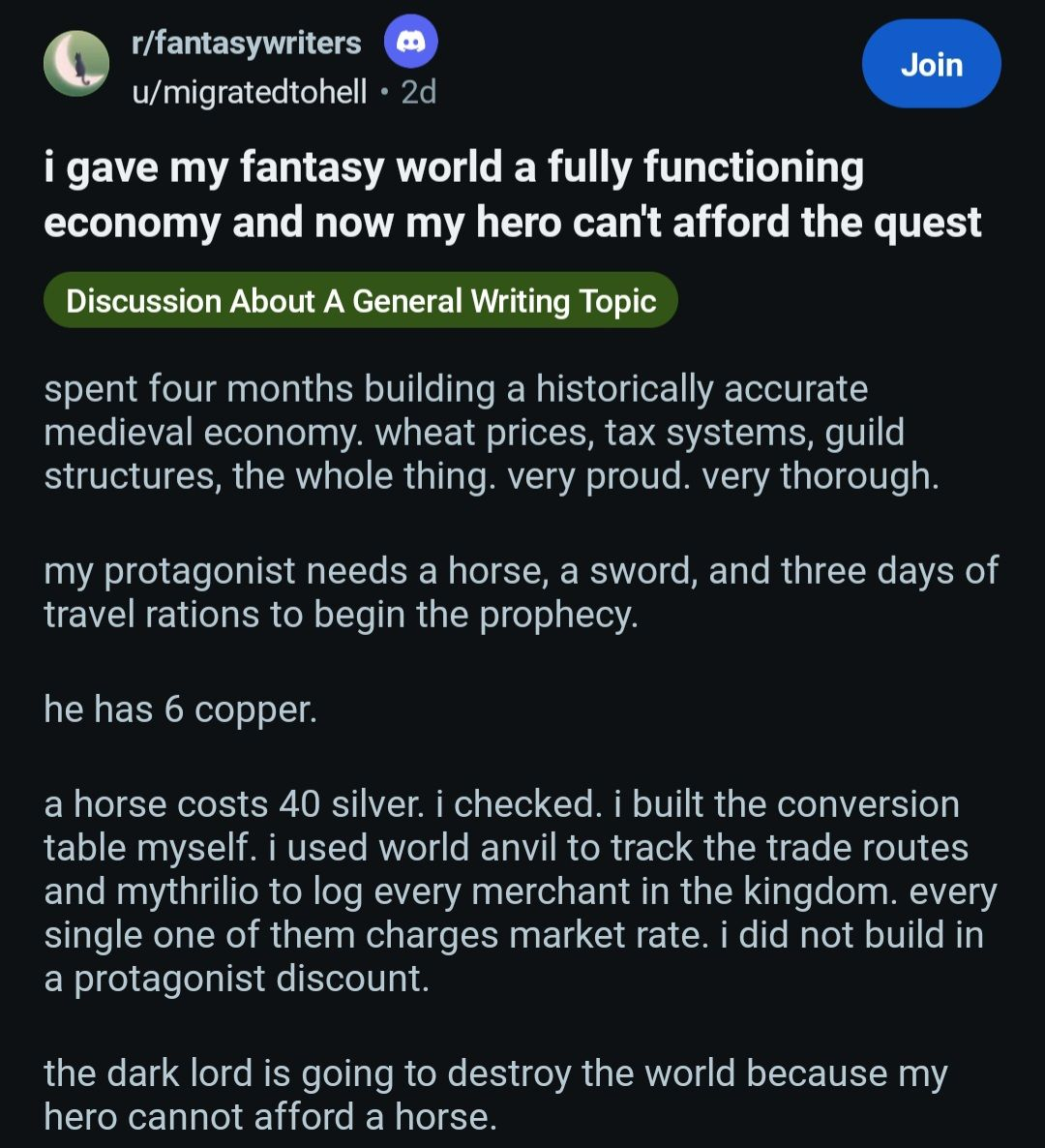
While I was writing this blog, this image from reddit started floating around social media — and it’s a great example of getting lost in the weeds of worldbuilding. There’s really two points to be made here:
While I was writing this blog post, this image from reddit started floating around social media — and it’s a great example of getting lost in the weeds of worldbuilding. There’s really two points to be made here:
There’s actually a lot of ways you can get around this – a non-exhaustive list of what your protagonist could do (thanks to a discord I’m in for some of these ideas):
Steal a horse
Beg for a horse
Seduce someone for a horse
Have someone gift a horse (in exchange for a good deed, etc.)
Have the protagonist start out with a horse (parents bred them, job involves them, etc.)
Drop the idea of a horse entirely and offer to guard a caravan or something for transportation and/or trade services for a horse
Not have your protagonist be arbitrarily locked into 6 copper
And… every horse is going for exactly 40 silver? Even the old ones? Even the bad-tempered ones? That feels very unlikely!
2. This is what I mean by “the world needs to serve your story”. You can create a simulation of medieval economics if you want, but if it makes it so that your story just stops, then that wasn’t very useful to your end goal – which was, if I may remind you, writing a story. If it makes it impossible for you to move forward, then something does have to change, either your plot or the world.
Also, I guess there's something to be said for an economic system that is so controlled that every horse must be sold for 40 silver, but I think the story that needs to be told there isn't necessarily an adventure one.
And on that note – you aren’t writing in stone. If something isn’t working or you come up with a super cool idea later, you can change things to fit it in, and that’s ok!
Feel free to leave some things vague to fill in later. Especially if you are the sort of person who wants everything set before you start writing, you still don’t want it to get in the way of actually writing the story, so if you are stuck on some bit of detail and it’s preventing you from moving forward, just leave it vague and move forward.
Decide how to organize your notes! Once again, there are a ton of ways you can do this. If you don’t know what kind of system will work for you, try a couple and see what resonates. Remember that it is important to find a system where your information is organized in such a way that makes it easy for you to find the info you need at any given point. A non-exhaustive list of options:
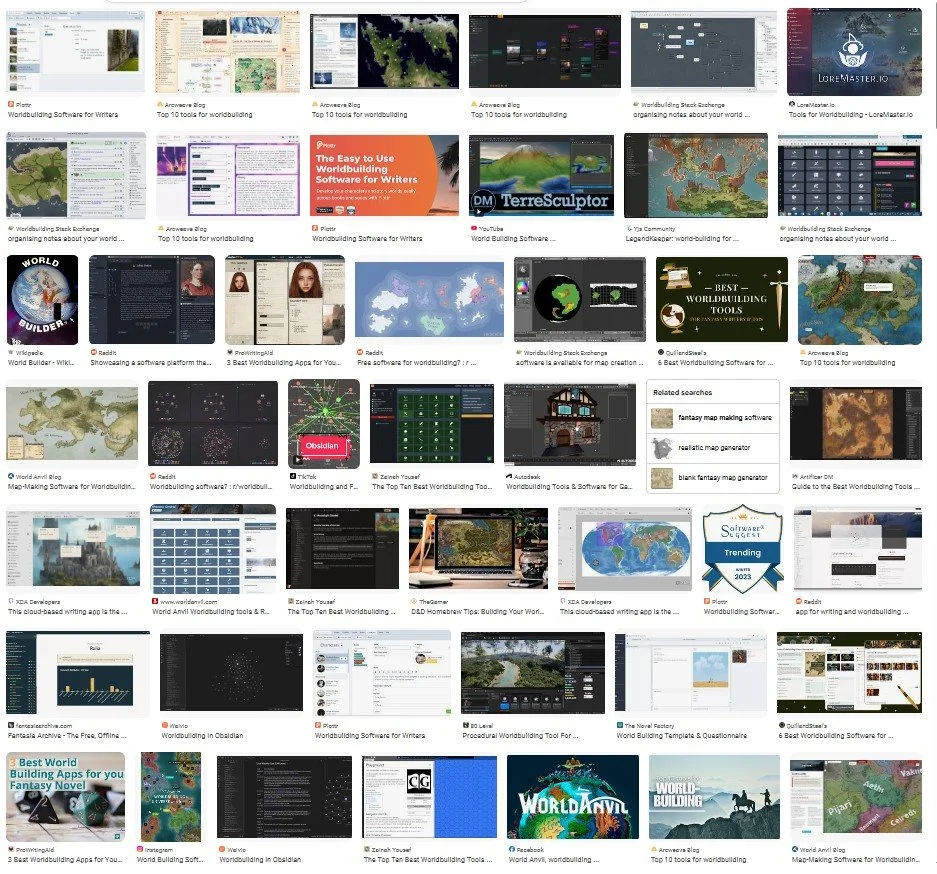
There are so many options. Find what works for you.
Google Docs
Word
Excel
Google Sheets
OneNote
A Wiki
A notebook
A system of notebooks
A combination of the above
(Again, the above is a non-exhaustive list. Terribly sorry if I left out your favorite.)
Some Recommended Ideas
Here are some ideas for things you can do to help you Write a World:
Make some maps! Even if they are just quick or crappy pencil sketches, both geography and political boundaries are important to how worlds evolve.
Create a pintrest board (or a series of pintrest boards) for inspiration/ideas/visual anchors.
Create a timeline (or multiple timelines) of events! Here’s mine, for an example. You’ll notice not every event in the history of my world is notated here; this is my “big picture” timeline.
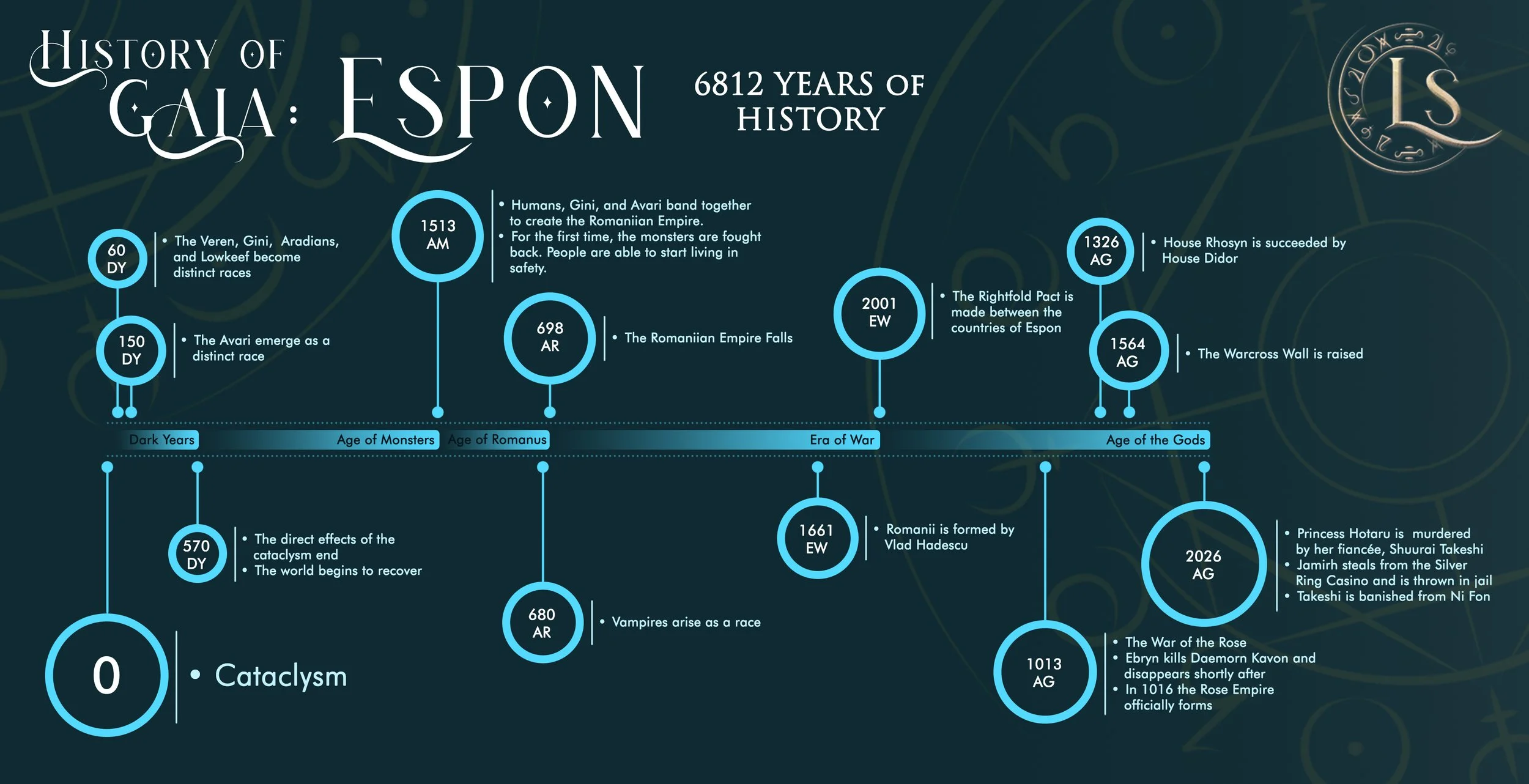
On the note of timelines, try to decide the span of what you want to work with. Also consider how fast your societies are evolving. The Roman Empire to today is about 2000 years, and Cleopatra reigned closer in history to the moon landing (a roughly 2000 year gap) than to the building of the Great Pyramid at Giza (a roughly 2500 year gap). Do with that info what you will.
Make sure things interact with each other! Nothing exists in a vacuum, and some fascinating story ideas can come out of an interaction you may not have thought of before writing things down.
Whether or not you have multiple races, keep different cultures mostly distinct – but also keep in mind that cultural exchange does exist, and again, can lead to some interesting happenings. In the absence of something that prevents people talking to each other, people will absolutely talk to each other, and this will result in some sort of blending.
Depending on the size of the area you are dealing with, remember that most planets that are similar to ours will have a variety of biomes. A lot can fit on one planet (a lot can fit in one planet if your people are capable of terraforming below the surface, actually). This can lead to a large variety in fauna and flora – how are your societies interacting/dealing with those?
Feel free to focus on the aspects that align to what you want to write about. You can’t really get away from politics existing, but if it’s not going to be a focus of anything you write, you don’t have to spend three months fleshing out the political intricacies of 16 different courts and governments that you are never going to use. Flesh out the basics and move on. (Having said that, if politics is your jam, have fun! Go wild!)
Keep in mind that you are creating this world for readers. If something is “realistic”, but is difficult for readers to grasp, feel free to drop it. For example: in the real world, sometimes different geographical features have multiple names granted by different groups. This certainly can be handled well in a fantasy world, but I’d caution you to really consider if it is necessary – if it’s going to confuse your readers, or is ultimately unimportant, don’t feel like you have to keep it (another example of this is character names – while it can be realistic for some parents to name their children Krista, Karla, and Karl, it’s not recommended to name characters in this way because it can rapidly get confusing to readers trying to keep them straight).
And that actually leads us to Tolkien!
The Tolkien Connection
Yes, let’s bring it back to Tolkien! I’ve mentioned this year is the 25th anniversary of the movies, right?
A lot of people hold Tolkien as the pinnacle of worldbuilding, and I’d argue he did, in fact, Write a World – he wanted a playground for the languages he had created. He did a ton of work on his “history” of the world (that’s basically what the Silmarillion is), and we have tons of letters and notes that have been published since his death that give an insight to his thoughts on his own worldbuilding. I’ve sometimes seen people use this as evidence that one should fully, 100% create the world they are writing in before actually writing in it.
But.
Tolkien was not a pure planner. Not even close.
In a letter to W. H. Auden in 1955, Tolkien said the following:
“I met a lot of things on the way that astonished me. Tom Bombadil I knew already; but I had never been to Bree. Strider sitting in the corner at the inn was a shock, and I had no more idea who he was than had Frodo. The Mines of Moria had been a mere name; and of Lothloriene no word had reached my mortal ears till I came there. Far away I knew there were the Horselords on the confines of an ancient Kingdom of Men, but Fanghorn Forest was an unforeseen adventure. I had never heard of the House of Eorl nor of the Stewards of Gondor. Most disquieting of all, Saruman had never been revealed to me, and I was as mystefied as Frodo at Gandalf’s failure to appear on September 22.”
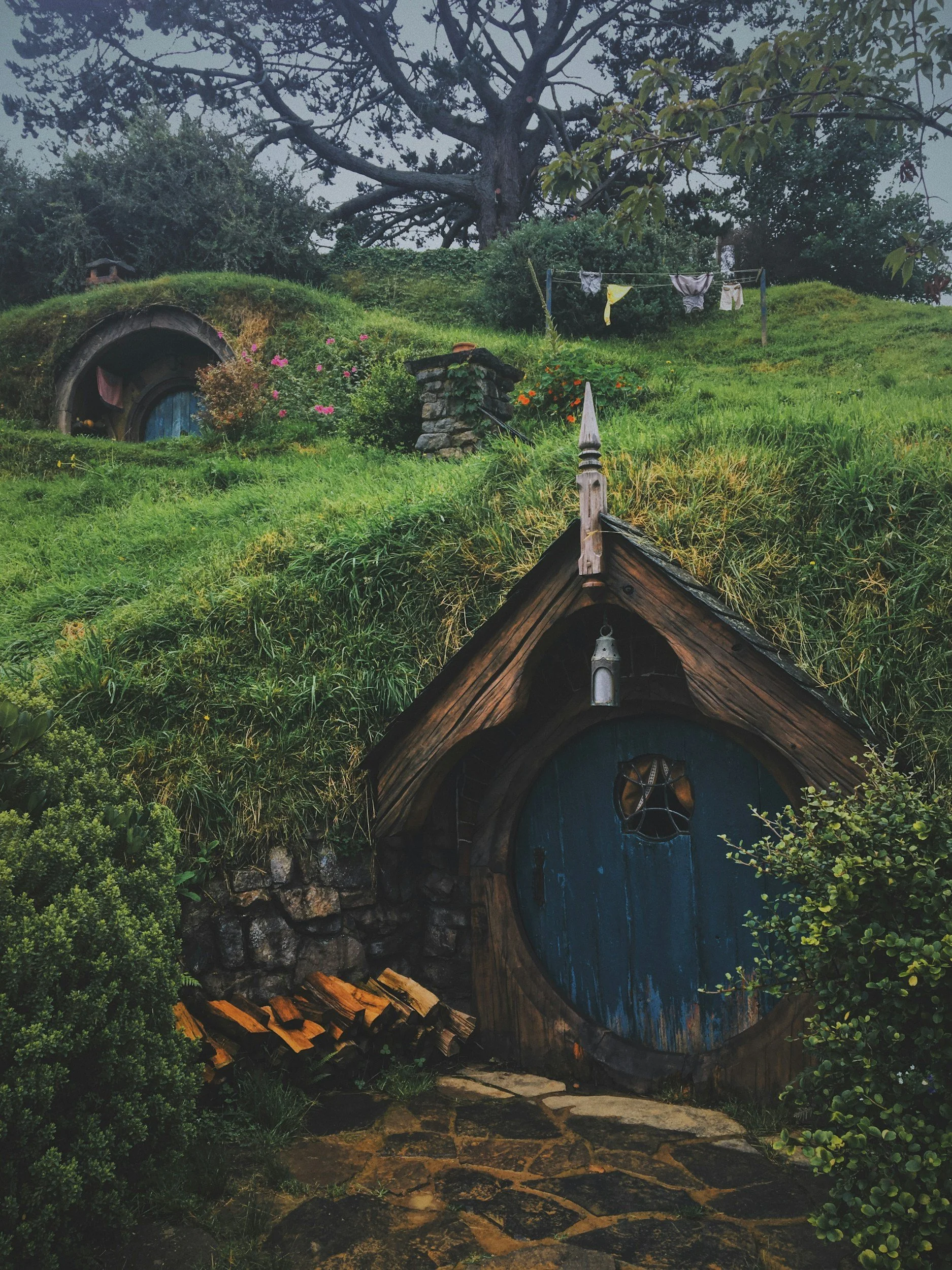
The rest of the letter is also a great read, and mentions that after The Hobbit had been published and a sequel had been requested, the mythology had to be re-worked (and on that note, The Silmarillion itself as-published is unfinished, and is a selection of documents from Tolkien’s notes that his son selected and published after his father’s death – and most of the other published material that is not The Hobbit or The Lord of the Rings proper is in the same boat).
Tolkien even went as far as changing part of The Hobbit after publication. Chapter 5, Riddles in the Dark, originally had a different interaction between Bilbo and Gollum, with Gollum willingly betting the ring on the outcome of the game and amicably leading Bilbo out of the caves when he can’t find it to give to Bilbo. This was later explained as being “the story Bilbo told Gandalf about how he got the ring”, since it paints Bilbo in a better light than the “true” series of events, which were told at the Council of Elrond in The Lord of the Rings (and The Hobbit was edited to reflect).
I bring this up as reassurance – give your world space to breathe and grow. Not everything has to be decided on immediately, or even at all. And in the end, things can always be changed.
So, no matter how you go about worldbuilding or writing a world, don’t panic. Decide on your goals and make decisions thoughtfully. Ask for help if you need it, and have fun! The world will come together :)
Cheers!
How do you worldbuild? Do you agree with my arbitrary distinction? Let me know below!